Return to run Blueprint
Do you have a running injury? Or are you trying to get back to running after an injury? Physio on Ross’s Nathan George has created a graduated Return To Run Blueprint to get you back to running safely and injury-free. If you would like to see one of our physios to guide you through and individualise the blueprint to your specific injury, you can call our reception at 07 4728 2116 or book online
My morning runs are some of the best (and worst) parts of my week. Dragging myself out of bed when the alarm goes off is miserable. Particularly when all I’d rather do is hit the snooze button and steal another half hour of sleep. And even once I’m out the door, those first few minutes feel brutal, my lungs are burning, my legs feel heavy, and I find myself questioning why I’m doing this at all. But then something shifts. The crisp morning air wakes you up. Your stride settles. You find your rhythm. All the busyness of life fades to the background, and all that you’re thinking about is the next step. And when you finish, there’s that deep sense of accomplishment, the sense of having done something difficult and made it through, that makes it all worth it. That’s why I love running. I’ve run a 19:56 5K in the past, and I’m currently chasing the sub-20 again. I am admittedly still a long way off the 20-minute mark, but the keyword is “chasing.” This year, I’ve also stepped into longer distances and completed my first half-marathon and full marathon. I know what it feels like to set a goal, struggle through the process, and feel the thrill of making it through.
But running isn’t without its risks.
I’ve experienced it myself, and I see it all too often in the clinic: knee pain that won’t settle, shin splints that flare up after a few weeks, stress fractures, and persistent tendon pain. It’s frustrating because most runners don’t want to stop. So they push through, only for things to get worse. Or they rest for a week or two, feel a bit better, and then the pain comes straight back after a couple of runs.
The questions we hear all the time are:
How long should I rest?
What exercises should I be doing?
What pain is okay to run through—and what means I should stop?
The honest answer is: it depends.
Every runner is different. Your symptoms, your history, your biomechanics, your strength, your mobility, all of these factors matter. There isn’t a one-size-fits-all solution, and there’s no single online plan or YouTube video that can perfectly guide every runner back safely.
That’s where seeing a physiotherapist makes a real difference. It’s not just about treating injuries, it’s about preventing them, identifying weak links, and guiding your return in a way that actually suits your body and your goals. Too often, runners get caught out by doing too much, too soon, or by following generic advice like the “10% rule.” While that can be a useful guideline, it’s not individualised enough. For some runners, a 10% increase is too much, while for others, it’s not enough to make meaningful progress.
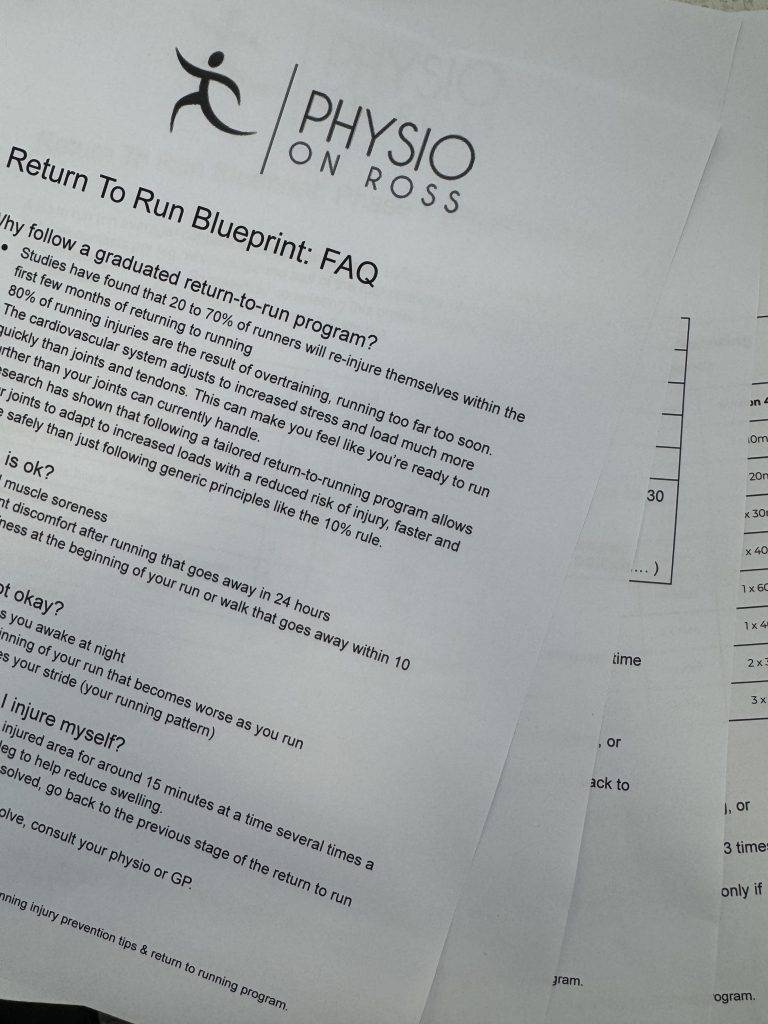
Research shows that anywhere from 20–70% of runners will re-injure themselves within the first few months of returning to running. Often, this tends to be because they don’t know how to safely and gradually progress their return to running. They either just “wing it” or are guided by an online program that is, at best, not tailored to them and their body or, at worst, downright harmful.
That’s exactly why we created our Return to Run Blueprint. It’s a step-by-step, evidence-based program designed to take the guesswork out of returning to running. It helps you build back gradually, improve resilience, and work towards your specific goals—whether that’s starting running for the first time, getting back to pain-free runs with friends, or chasing that ever-elusive personal best. It is implemented in 3 structured phases that build on each other and are tailored to your individual strengths, weaknesses, and goals by our physios. With the right guidance, structure, and support, you don’t have to be a part of the re-injury statistics; you can come back stronger, healthier, and more confident than ever.
Written by: Nathan George